



Thoughts: The Substance Out of Which the World Is Born
"Man proposes, God disposes." This pious phrase echoes an age which has just elapsed. Now, in the Age of Aquarius, man is called upon to develop the 'Buddhic consciousness' - which means no less than to think God's own thoughts.
"I think, therefore I am". Famous though this statement by French thinker René Descartes may be - it is nevertheless fundamentally unsound. For the capacity of thinking is a relatively recent achievement of human evolution. Millions of years ago human beings were linked more inwardly with the divine precisely because their intellect still slumbered in the depths of a dream consciousness. Like sorcerer's apprentices, they still handle the very quality that constituted proof of existence for Descartes and distinguishes human beings irrevocably from animals, plants and minerals according to the motto "...they know not what they do". Surely we have witnessed the most powerful proofs of the destructive power of all-too-human thinking ever more frequently and painfully in recent years. They appear as earthquakes, floods, volcanic eruptions, droughts and tornadoes. Natural catastrophes are a direct consequence of misguided human thinking, and instead of wallowing in self pity every time we bewail the victims of such a catastrophe, it would be wiser and more mature of us to reflect for once about what man is doing wrong to make nature burst its banks so grievously.
The seed of thinking germinates
As already mentioned, the seed of thinking slumbered in early prehistoric man over vast periods of time without awakening. Then suddenly, at the time of old Atlantis, the waking call sounded. Prior to that, man had been purely a being of desires and feelings (having lost his state of original innocence and purity through the "Fall of Man"). But now the hand of the world clock showed that the time had come for him to start worrying his head about being and non-being, cause and effect, meaning and purpose - and thus to move from inchoate fragments of knowledge to ultimately recognizing and learning to use the great mysteries of the creative laws of the cosmos.
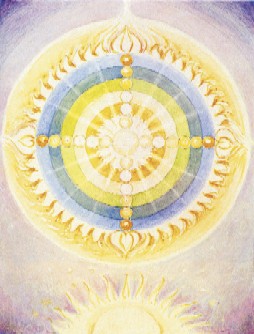
A thought about the divine spirit in all things. This form reveals the sacred numbers 24 (12), 5 and 40, which are also of great significance in the Bible.
But the newly awoken capacity of thinking demanded its tribute. Man lost his power over the forces of nature. His innocent forebears who dwelt in a long past Golden Age could see angels and nature spirits and lived with them in a spirit of fraternity, and their successors could still wield powerful forces. The monumental buildings which amaze us today as prehistoric marvels bear witness to the fact that early man knew the secret of dematerialization and levitation. There is no other way of explaining how the pyramids or ancient cult centers like Stonehenge came to be built. But now that he was granted the magic wand of the intellect - a spiritual force that could conceive of heaven - but also hell - the old power over matter was taken from him, and his third eye was closed, shutting him off from direct vision of the worlds of fine matter. Thank God, we sigh with relief. His unbounded godless intellect hand in hand with immeasurable power over the forces of nature and matter would otherwise have put an end to life on earth long ago. When man learns to be master of his thoughts and feelings, and to use them only in a constructive sense, he will regain these forces - and nothing will stand in the way of creating a 'paradise on earth'.
The stages of education of humanity
It is important to be aware that man is by no means a fixed ready-made product. Thus we currently see human beings on earth of very diverse types - the aboriginal inhabitants of Papua-New Guinea with their highly archaic lifestyle, or Australian Aborigines, as well as the North Americans with their focus on the intellect and all the stages between these two extremes. In the same way, humanity as a whole has changed fundamentally in the course of the ages: contemporary man by no means represents the "crown of creation". For man of the future will possess not only developed instincts and a highly trained intellect, but also unfailing intuition and a well-endowed capacity for inspiration. He will regain his clairvoyant faculties and look back on the human beings of the 21st century much as a contemporary American academic might regard a member of a Pygmy tribe. But with one big difference, for contemporary Pygmies are gifted with an innocence and an intimate connection with nature completely unknown to the oh-so-cultivated 'elite' of our contemporary civilization.
Rosicrucian Max Heindel names four phases of the 'education' of the human race:
- Human beings are influenced from outside without being aware of it (Hyperborean and Lemurian epochs).
- They are placed under the guidance of divine messengers and kings (often originating from Venus), whom they can see and whose commands they must obey. (Atlantean epoch).
- They are taught to follow the commands of a God whom they cannot see. (The last twelve thousand years, i.e. the post-Atlantean epoch.)
- Finally, they learn to raise themselves above these commands by embodying the law and overcoming themselves out of their own free will by living in harmony with the laws of nature, which are the laws of God (our future, which is now in its germinal beginnings).
This process is associated with the four stages of man's worship of God. In the very beginning:
- He worships God, whom he begins to sense, out of fear. He offers Him sacrifices like a fetish-worshipper in order to reconcile this malevolent, vengeful God who is to be feared.
- He learns to recognize God as the giver of all things and hopes to gain material benefits from Him in the here and now. He performs sacrifices out of avarice and expects that the Lord will reward him a hundred-fold. And also hopes to escape His punishments by the agency of plagues, war etc.
- He learns to worship God through prayer and by leading a good life. He nurtures a belief in a heaven in which he will be rewarded in the future. He must refrain from evil in order to escape future punishment in hell.
- Finally, he reaches a point at which he can do good without any thought of reward, bribery or punishment. He now does what is good simply because he feels it's the right thing to do.
Heindel continues: "The primeval Semites had attained the second stage, and Christianity the third stage. The esoteric Christians and pupils of all occult schools now endeavor to reach the highest level, the fourth stage. As Heindel says: "Then the uniting Christian religion will open the hearts of men just as their understanding is now being opened."
Attainment of this stage is linked directly to knowledge. By thinking, man does not act simply because he is commanded to do so and cannot do otherwise, but because he has gained wide freedom of choice. By practicing it, he has learnt to distinguish between good and evil, to separate the chaff from the wheat - and has decided to become wheat.
(…)
Descartes and the Fata Morgana
Every deed is the child of a thought. A thought is the crystallization of the will impulse, which is the arrow bearing a desire to reality. In the beginning was the spirit, and this created the entire universe by means of thought, of the primal word: "Let there be light".
Thoughts are a fundamental power of creation. Everything that a human being can conceive of can also be realized - sometime, somewhere. The human being becomes what he desires - but as he lets his thoughts run wild, he is rarely happy with the result. Because he has softened his will and has become lost in the jungle of his desires, he ends up in chaos and complains bitterly about the apparent lack of a way out of his fate. But that's the whole point - where there's no will there's no way either, but merely a labyrinth.
Let's return to Descartes. Even now, 350 years after writing his famous "I think, therefore I am", this statement continues to wreak havoc. Descartes had struggled his way to this oasis after almost perishing in the desert of doubt: "I think, therefore I am", "I doubt, therefore I am", "I am deceived, therefore I am". But the "oasis" which saves the philosopher from his desperation turns out upon closer inspection to be a Fata Morgana, an illusion. Indeed, no less than the second expulsion from Eden.
After all, medieval man still found his ultimate certainty, the answer to his torturous questions, in God. After Descartes, he had to find the answers in himself. The heavenward gaze of faith had become a doubting earthward gaze; and Descartes was aware that this gaze would lead to men sinking in the night of skepticism. He even described himself toward the end of his life as "a human being who walks alone and in darkness".
Descartes' credo marks the beginning of the triumph of the human intellect. Bleak and increasingly merciless, it sweeps over the land, drives out heart and feelings and breeds its infamous brood - utilitarian thinking and expediency. It swells the head and applies a tourniquet to the heart until nihilism and widespread cynicism determine the development of humanity. The heart, the soul and the feelings ultimately become nothing but yellowing recollections in a personal poetry album relegated to granny's attic. After all, aren't we enlightened! (Which is perhaps why more and more things are going awry today.)
And now that we have learnt to shudder so properly in the face of the steely smooth ice-cold materialism into which we have, like moles, buried ourselves, the call is becoming increasingly impossible to ignore. The 'voice of the silence' begins to stir and insists on being heard, rebelling inwardly against the noisy thoughts flooding the world. Suddenly we become so weary of all this noise that all we want is to switch off. Away, only away!
And on that day on which we, breathless and exhausted, consciously read a wonderful and edifying book, without murder and killing and sex and lies, on that day we have won a small but significant victory. We have made our first conscious effort of will toward wanting to live in heaven rather than in hell. For thoughts are things. Omraam Michael Aivanhov says on this score: "Every thought is an individual that tries to live as long as possible. All similar thoughts combine and strengthen each other." Ever since man has lived on the earth, he has created mighty thought beings by his incessant streams of thought, which swirl around the earth (they remain earthbound and may not leave the terrestrial sphere, the rest of the universe being keen to avoid our mental garbage!). And man is quite simply the transmitter who aligns his aerial either to 'heaven' or 'hell'. For like attracts like. If he gives himself up to dark thoughts, he immediately becomes caught up in the mire of the same murky thought mass that fills the ether. He sinks in it to the point of drowning, a condition known today as depression. If he makes the effort to block out the gloomy thoughts and to devote his attention to beautiful, noble and good things, he picks up heavenly thought forces borne by angels. If he does this often enough, his thought channel may become so refined that he becomes capable of receiving heavenly inspiration. For most of the original ideas which man espouses have not grown on his dung heap. They are suggested to him, stream to him, 'occur' to him, as common speech so aptly says. They come from an angel of thought, whose number is legion. Or else he has tapped into an ancient primeval thought form that has existed in the ether for centuries or millennia or even much longer, brought forth by long gone civilizations and waiting to be rediscovered by a human being. After all, as the proverb says: "There's nothing new under the sun".
(…)
The right and left brain hemispheres
Human beings have two quite distinct brain hemispheres. The left one is a super-fast computer, an analytical signal converter. In a jiffy, it absorbs the impressions it receives and, lo and behold, analyses them into a usable form. Let's be clear on this point - the brain does not generate thoughts, it merely picks them up. Thoughts consist of etheric substance. The brain is the first converter on the path to matter. It is followed by the feelings, the will to action and finally the concrete action itself. In this way, the abstract idea becomes a physical reality.
The right brain hemisphere is more dream-like. It receives images, creative thoughts, ideas. It is - would be! - the recipient of divine inspirations, be this one's own divine presence, an angel or a master - or simply a very lofty divine thought form that seeks a channel in order to be known: hello, humanity, don't I represent a solution to your problems?! That's why all prophets and seers receive their revelations in images. Often, these are mere metaphors for processes of consciousness. So a vision of the end of the world need not necessarily mean that continents will sink beneath the waves and the heavens will be physically darkened, but that perhaps an earlier world of belief disappears to give way to new knowledge.
As we go through the streets we should really be amazed that most people don't walk around with their heads tilted to the left. Our brains have become so strongly left-leaning: fixed entirely on rationality, the physical reality, everyday matters. Oriented unremittingly to external impressions, never turning inwards. Quite apart from that, the average human being has become so identified with his physical body that his brain has become the master of his thoughts. Like in an automaton, his five senses continually feed impressions to his left brain hemisphere (which is absolutely right). However, as they are the only type of thoughts which get through to him, only the left brain half is used, and he ultimately considers every thought from an exclusively physical standpoint. His right brain, open to the higher worlds, atrophies, becomes deaf as a post. There comes a time when it no longer has any antennae which might even conceive of metaphysical truths. That's why human beings who are strongly bound to material life (including many conventional scientists) often have no wish to know anything about higher things: their organ of perception for higher realms has become stunted and unusable due to lack of use over many years, decades or perhaps even lifetimes. And just as a badly injured person needs a long period of recuperation and retraining to re-use certain muscles again, such a 'one-sided' person can tolerate metaphysical reality only in homeopathic doses.
Hearing the voice of the silence
Meditation can prove valuable in balancing the two cerebral hemispheres. By sitting in silence and concentrating on a mantra or on our bodily processes, we switch the left half of the brain off sufficiently to allow the right hemisphere to gradually 'talk' to us. Hence the wonderful impressions and experiences often received by those practiced in meditation. The control of thoughts depends fundamentally on slowing down the activity of our left brain for long enough to perceive the still, quiet spiritual voice previously completely drowned in the cacophony of external noise. Hence the proverb "silence is golden". Only in silence can the golden 'treasure' of enlightenment, which comes from inner thinking, be real-ized!
Often, however, our brain is like a busy amusement park, full of sensation and pleasure seekers roaming about in search of sensuous or other adventure. "Thou shalt not let thy senses make a playground of thy mind", wrote Helena Petrovna Blavatsky in her book The voice of the silence. To tame one's own rampant thoughts and whip them energetically back into line every time they threaten to degrade into any form of impurity is a long and often Sysiphus-like task awaiting all those who set out on the 'path'. Every impure thought must be rejected immediately. However, it is most important not always to suspect evil behind everything and play Sherlock Holmes with our thoughts. So don't wake any sleeping dogs but pass them quietly by, keeping your gaze fixed on the sun in the sky. Of course we should not go through the world in ignorance and without becoming involved; by no means. But how often do we mull over some event or behavior, zealously trying once again to find out what lies behind it and ultimately causes us pain? Right thinking will eventually turn our passions into joys.
There is still much more to read in this 9-page treatise. You will find the whole text in our Facts are Facts print edition no.1.