



Panic Attacks: The Trick With Adrenalin
Panic attacks and anxiety are frequently a consequence of exhaustion and poor nutrition.
Sound familiar? "I have the feeling that something terrible is going to happen, and I start shaking from head to toe. My mouth is dry and I can't swallow. It usually happens when I am shopping. As soon as I go outside into the fresh air it stops. "This is the way Sandra, a young woman in her thirties, describes it. Mark explains it like this: "I feel very weak, as if I am about to pass out, and I can't seem to catch my breath. I start to perspire, and from my girlfriend I know that I become very pale. I always feel terribly helpless and I am certain I am about to die. Afterward I feel really foolish." "My thoughts are all confused and what I say sounds confused as well", says Monika. "Each time it happens I have the feeling that I am about to have a stroke. Everything around me looks unfamiliar. Fear takes over, and other people have a very hard time convincing me I am only having a panic attack. Of course later on I realise this myself, but while it is happening I become furious if anyone so much as hints that my nerves might be getting the best of me."

Like a bolt out of the blue: Panic attacks are avoidable.
Gundolf Wiedenbruch understands this phenomenon and knows many people who suffer from panic attacks. Seemingly uncontrollably they take hold of people, make their hearts race, their blood pressure zoom upward, their thoughts run amok. With difficulty some people manage to make it to the nearest toilet; others just barely avoid passing out. Gundolf Wiedenbruch knows what causes these attacks: a rush of adrenalin in the blood. He also knows how one can successfully prevent anxiety and panic attacks. Mainly they have to do with two factors: incorrect breathing and the wrong diet.
Wiedenbruch: "The first ‚food' the body needs is light. Man is an immortal being of light that dwells in a visible, physical, mortal body. So above all every human being needs light. Instead of going to the chemist's and buying hormones, we are better off finding light so our bodies can produce these hormones themselves. So the right path takes us back to nature, back to God.
"The second most important nutritional factor is breathing. Next come liquids, in large amounts, and this does not mean Coca-Cola, which is filled with so much industrial sugar it should actually be banned. A water deficiency alone can cause panic attacks."
Here we quote a doctor named Emile-Gaston Peeters, who said the following about cola drinks: "These days the so-called cola drinks on the European market contain some 21 mg of caffeine and 102 mg of phosphoric acid per 0.19 litres (contents of a small bottle). Caffeine has a strong stimulant effect. Phosphoric acid is highly acidic, and due to its high phosphorus concentration there is a risk that the balance of calcium and phosphorus in our diet will be disrupted, which can lead to a serious calcium deficiency in the bones. And finally it should be guaranteed that this phosphoric acid does not contain excessively large traces of toxic heavy metals. The final conclusion is simple: children and young people must be definitely advised not to drink so-called cola drinks as they are currently comprised. They are healthy for no one."
This scientific opinion is confirmed in an article in the Deutschen Presse Agentur, which came down the wires in early 1997:
"Cola seems to cause bone shrinkage in children. - Munich; 8 January (dpa). More and more children are being treated for bone deterioration (osteoporosis). The causes include serious nutritional deficiency, writes the newspaper Ärztliche Praxis. The soft drinks that children love, such as cola and other drinks, are absolute ‚calcium thieves' to the detriment of the bone tissue. The youngest known osteoporosis victim in Germany, according to the professional publication, is an eleven year old child. The child's diet was mainly cola drinks and pastries. The consequences were broken bones at the slightest provocation."
Wiedenbruch: "These days we are at the mercy of an industry of artificial flavouring. The food industry has constructed a world of illusion in which flavouring is the temptress of our senses. It tastes like a strawberry but is not a strawberry, so of course it does not contain what a strawberry would contain, but is in reality wood shavings."
No kidding! Here we quote from the expose-style, shocking book Your soup is lying by Hans-Ulrich Grimm: "Wood shavings, for example, were not part of the human diet in the past, but were only used as a raw material for making chipboard. Narrow-minded, obtuse, unsatisfying. At Haarmann & Reimer (a flavouring manufacturer in Holzminden, which is a subsidiary of chemical giant Bayer), they make strawberry flavouring out of wood shavings." The author of the book managed to get the approximate recipe from the chemical flavouring producer: "So you take wood shavings, more precisely: Australian wood shavings. Would sawdust do as well? No, smiles the man, it really has to be wood shavings. You add alcohol and water, then a few other ingredients (secret, secret!) and mix it to form a mushy substance. ‚Then you cook it a while', says the wizard of Haarmann & Reimer, and before you know it 'I have a lovely, natural strawberry flavour'. With a slightly changed recipe the mutated shavings can also pass for raspberry flavouring, or cocoa, chocolate or vanilla!"
Wiedenbruch: "In addition we often feed ourselves with empty calories. Many people who suffer from nervousness and fear forget that the brain is an engine that needs its fuel. For the brain this fuel is glucose. If this is lacking, the brain responds and acts crazy. The individual is subjected to all kinds of strange information and crises, for example unexplainable fear, depression or even hallucinations. Often the culprit is solely a glucose shortage in the brain! An engine without petrol, after all, begins to knock and finally fails to perform at all.
"Once again: the brain needs light and air; air that contains not only oxygen, but also so-called Pranha, which is a very high quality nutrient for the nerves. In addition man needs sufficient water (the brain consists of 90% water). The brain and nerves need sufficient B-complex vitamins, and glucose. "
Gundolf Wiedenbruch has already managed to help numerous people who suffered from panic attacks and unexplainable anxiety. The man who already explained in the German edition of ZeitenSchrift how to work with angels has been studying the problem of panic attacks for years. And it is important to him to explain the link between the ‚soul' and the ‚body' to people, so that they know that their body, according to Wiedenbruch, "possesses the consciousness of a four to six year old child" and would like to be treated as an intelligent, responsible being - and not always be subjected to junk food that is hostile to life.
Wiedenbruch: "An example: The manager drives to work on Monday morning. On Sunday he had visited his mother, and ate her delicious cake made of lots of white flour and industrial sugar, and in the evening drank wine or beer. In the morning he prepares for a business trip and ‚of course' has no time for breakfast. On the autobahn later that day he finds himself in a traffic jam and the time pressure increases. Under such stress he is not accustomed to breathing correctly. ‚Of course' he has no drinking water with him, or anything to eat. His entire nervous system switches to alarm mode. Because of the stress he is using large amounts of energy and his brain is not receiving any energy from his body. Slowly a deep in the body rooted fear begins to spread throughout him. It becomes stronger and stronger, he cannot breathe, his heart tightens and he has the feeling that he will not survive.
After this attack he drives himself to the hospital where he is thoroughly examined. In the end the physicians admit that they cannot find anything organically wrong. And the bad thing about this situation is: the man does not know what caused the attack - and most physicians would not know, either. So after the initial shock he continues living as before, eating cake at Mama's on Sunday, and drinking acidic coffee along with it. And sooner or later he has the next attack - and once again the doctor says ‚there's nothing wrong with you'. And so it continues, until the man becomes weaker and weaker, more and more fearful, and possibly one day he stops leaving his house altogether. In the worst case he even ends up in a wheelchair with suspected multiple sclerosis. And all the specialists are at a loss. The actual diagnosis is: a massive adrenalin burst due to glucose deficiency in the brain, water deficiency, oxygen and Pranha deficiency, an absolute overload on the entire nervous system, with one of the reasons being stress. - All these symptoms are curable.
"But sooner or later such people are always labelled fakes, crazy or neurotic, finally landing at the psychiatrist's. A good psychiatrist first studies the lifestyle of his patients and asks them how they sleep, how often they exercise, and: what do they eat?
"Because there is a clear correlation: The more bad carbohydrates you eat, the less good happens in the brain. (You can read more about ‚good' and ‚bad' carbohydrates in the article ‚Diets make you fat! So what makes you thin?').
"When you have eaten a normal meal, after two hours the blood sugar level starts to sink step by step. After two and a half hours nervousness occurs, you become more aggressive, and after three hours you are on fire, because the brain is shrieking ‚I need glucose!' Now the brain attempts to obtain the glucose it needs, as cortisol and adrenalin are released via the adrenal gland. This activates glycogen in the liver to send glucose to the ‚hungry' brain."
Shirley Trickett remarks on the subject in her very definitive book Successfully overcoming anxiety and panic attacks: "If the adrenal cortex must produce all the time, the result is so-called adrenalin exhaustion; the body is no longer capable of breaking down stress. Fear, panic attacks, depression, irritability and perhaps even personality changes are the consequences of the fact that nerve cells are always deprived of nutrition." Her list of further symptoms is a long one: dull headache, inner shaking not perceptible externally, a craving for sweets, waking up between three and five o'clock in the morning, fearfulness, and sometimes hunger, tiredness in the morning and afternoon, eyelid spasm, a feeling of hunger approximately one hour after the last meal of the evening, no desire for breakfast, concentration difficulties, sensitivity in the realm of the pancreas and painful areas in the top of the left lower ribs.
Wiedenbruch: "If a person recognises that his panic attacks can have not only psychological causes but can also be provoked by stress and nervous exhaustion, for example caused by poor nutrition - call it an unstable blood sugar level - he has found the key to solving his problem. An old saying points the way: ‚Eating and drinking hold body and soul together.' Indeed, eating holds our four lower bodies (the physical, the emotional, the mental and the etheric) together, whereas an excessively low blood sugar level makes them simply drift apart. Then some people have the feeling they are about to pass out. People who don't feel solidly attached to the ground, who feel they only need to be touched lightly and they will fall, are often lacking the element Earth: too little glucose, minerals, vitamins, water, and incorrect breathing. This results in an excessively low blood sugar level. Particularly people who have been at one time or another emotionally injured use more energy due to their subliminal fear, so that they often have a tendency toward a low blood sugar level.
"Therefore, patients must start to breathe, to eat and to drink regularly, above all good, light-containing food that is rich in high-quality carbohydrates. This gives the body a sufficiently large energy and glucose supply, so that no more energy crises will occur, that would otherwise manifest as states of anxiety, hysteria and panic attacks. Even a ‚hangover' on the morning after a night of looking too deep into the bottle is the consequence of a glucose shortage in the brain. Alcohol influences our blood sugar level just as negatively as does black tea, coffee or cola. Not even mentioning such medications as the birth control pill, steroids, tranquilisers, sleeping pills, beta blockers and such drugs as heroin, cocaine and cannabis.
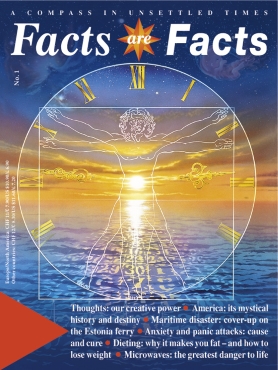
Get the whole interview that is filled with prime and easily adaptable information in our Facts are Facts print edition no.1!
In the long run, a diet is the surest way to become fat. So is there a way to enjoy eating and remain thin? Yes! With a method that the Frenchman Michel Montignac has discovered: Diets make you fat! So what makes you thin?